
There are certain skills worth learning that could literally save someone’s life. Below we’ll explore 7 key examples that could empower you to act confidently in an emergency. Please note that this guide is no substitute for professional training – while it offers a few tips on what to do, safety courses are the best way to properly learn these skills.
CPR (Cardiopulmonary Resuscitation)
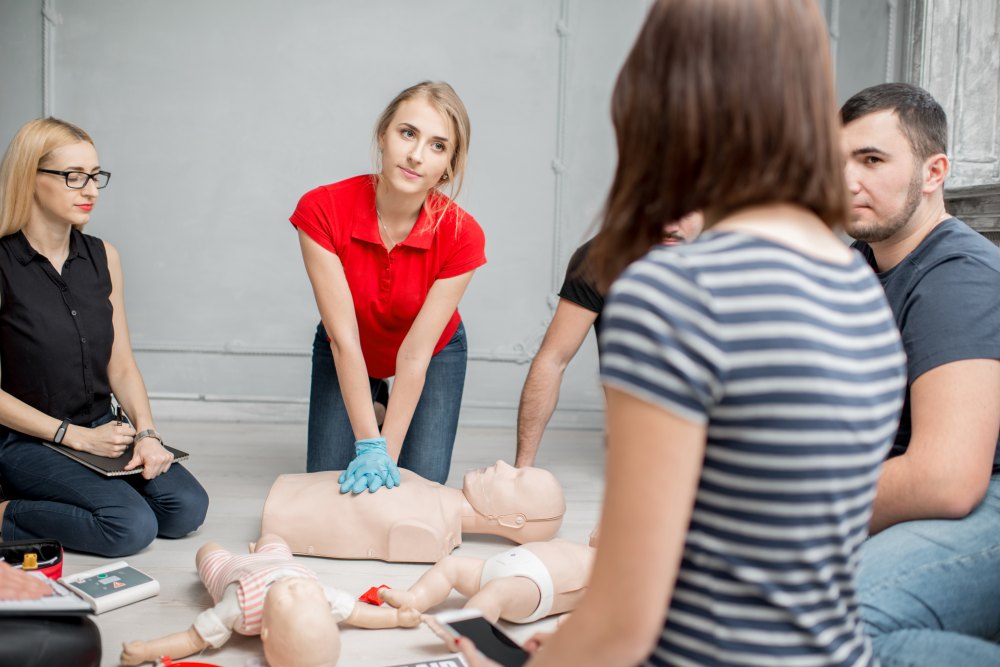
Cardiac arrests are a leading cause of death. This is when someone’s heart stops beating, causing them to fall unconscious. CPR (cardiopulmonary resuscitation) is a life-saving technique that can keep blood and oxygen flowing to the brain after a cardiac arrest. It involves steady chest compressions using the hands followed by rescue breaths every 30 compressions. While reviving someone through CPR alone is rare, performing CPR can greatly increase someone’s chance of being resuscitated once paramedics arrive (typically done with an automatic external defibrillator). CPR classes can teach you how to perform this technique using a mannequin, while BLS certification classes may also teach use of AED. This is one of the most valuable life-saving skills that you can learn – knowing how to perform CPR allows you to act quickly when someone has a cardiac arrest, which is key to increasing their chances of survival.
The Heimlich Maneuver
If someone is choking on food, the Heimlich maneuver can be used to dislodge this food. It involves standing behind a person, wrapping your arms around the waist, making a fist with one hand just above the navel, and thrusting inwards and upwards sharply. This is repeated until the object is dislodged. The Heimlich maneuver is usually only used if repeated back blows do not work. Young kids and pets may require different techniques, which you can learn on specialist courses. Techniques like emergency airway puncture can be used if the Heimlich maneuver does not work, but are best performed solely by a medical professional. There are many courses dedicated to the Heimlich maneuver, as well as general first aid courses where you can learn this skill and CPR.
‘Stop the Bleed’ and Tourniquets
In situations where someone is bleeding heavily, learning bleed control techniques can be vital for keeping them conscious and alive. The ‘Stop the Bleed’ method teaches to apply direct pressure on the wound with either your hands or a clean cloth, and to elevate the limb above the heart if possible. Deep wounds may be possible to pack with gauze, or tourniquets may be recommended (wrapping a band or cloth tightly around a limb to cut off blood flow during major injuries). Such techniques are often taught in first aid courses, potentially along with techniques like how to apply a bandage for less extreme bleeds. If you work in an environment using sharp tools, having these skills could be vital to have just in case an injury occurs on your shift.
The Recovery Position
When someone is unconscious but breathing, putting them in the recovery position is recommended to prevent them accidentally choking on vomit or their own tongue. It involves rolling the person onto their side, bending the top leg at the knee and holding out the arm to keep them in that position, and tilting their head back to keep their airway open. Common emergency situations in which you should use the recovery position include seizures, fainting and overdoses. It’s worth noting that the recovery position alone won’t bring someone back to consciousness, so always ring emergency services as soon as possible. Many first aid courses can allow you to practice putting someone in the recovery position, so that you know that you have got the position correct.
Administering an Epi-Pen
Serious allergies (such as nut allergies or bee sting allergies) can lead to a fatal condition known as anaphylaxis. This is when the body goes into shock, causing the airway to restrict and blood pressure to drop. Anaphylaxis develops rapidly and can often be fatal unless assistance is provided immediately. People who are prone to such allergies typically carry an Epi-Pen – this is a syringe-like device that contains a dose of epinephrine to immediately counter anaphylaxis. If you know someone with such an allergy, make sure that you know where they store their Epi-Pen so that you can access it in an emergency. To administer the epinephrine, remove the safety cap of the Epi-Pen, hold it firmly and then jab it into the outer thigh (this can be done through clothing) for about 3 seconds. There are videos online that you can watch to teach you how to administer an Epi-Pen.
Stroke Symptoms Recognition (FAST)
A stroke is a blockage to the brain, which can starve the brain of oxygen and lead to brain damage. Those with heart disease are often more prone to a stroke. Recognizing stroke symptoms early can allow you to get medical attention quickly, reducing the amount of damage caused. FAST is an acronym used to help identify the symptoms of a stroke – it stands for Face (is someone’s face drooping?), Arms (can they hold up their arms?), Speech (is speech slurred or slow), Time (time to call the emergency services!). While waiting for emergency services to arrive, lie them down and keep them calm. If they lose consciousness, CPR may be required. FAST is often taught during first aid classes. There are many videos you can watch online to help you better understand the symptoms.
Water Rescue
Knowing how to save someone who is drowning is another valuable skill to have. If possible, stay out of the water and reach out to them with a pole or another long item. If you have to get in the water, in-water rescue training techniques can be worth learning – this involves approaching from behind, securing them with one arm around the chest, and swimming back using a sidestroke. You need to be a strong swimmer to perform in-water rescue – courses such as lifeguard programs can delve deeper into these techniques and could be worth exploring if you spend a lot of time at sea or in the water.
Learning New Skills will Always Help You Have a Better Life
Snag a free workbook and get inspiration on all the ways to love your life even more.
>>Read More Strategies to Get Your Life Back on Track<<
You May Also Find These Articles Helpful
 Eighteen Reasons Why Awareness is Worth the Trouble (If You Want to Love Your Life)
 Inner Confidence: The Quiet Power of Owning Your Worth
 When You’ve Fall Down the Rabbit Hole: 17 Ways to Climb Out
 Bullet Journal Tips (And Why It’s Saving Me)
 Why Keeping a Diary is the Saving Grace I Need Right Now