Let’s talk about something you might not think of as self-care: your walls.
You already know that decluttering your closet or clearing off your kitchen counter can lighten something in your chest before you’ve even finished the job. What’s harder to notice is that the same principle applies to what you hang up, what you look at every single day without really seeing it. Your home doesn’t just reflect the life you’re living. It shapes how that life feels from the inside. And the walls you pass a hundred times a week are part of that quiet, constant influence, whether you’ve ever paused to consider them or not.
Why Your Walls Affect How You Feel
There’s real research behind the idea that your surroundings aren’t neutral. A study published in Personality and Social Psychology Bulletin found that women who described their homes as cluttered were more likely to report fatigue and depressed mood than women who described their homes as restorative, and clutter has also been linked to elevated cortisol, according to a summary from behavioral health provider Kolmac. Your nervous system is always reading the room, even when you’re not consciously doing it.
Art plays a role here too. A 2025-2026 study published in Applied Psychology: Health and Well-Being found that simply viewing art led to greater subjective well-being and lower stress than neutral activities, with the biggest benefits showing up in people who started out most stressed. That’s worth sitting with. The art on your wall isn’t decoration in the throwaway sense. It’s doing something to your body.
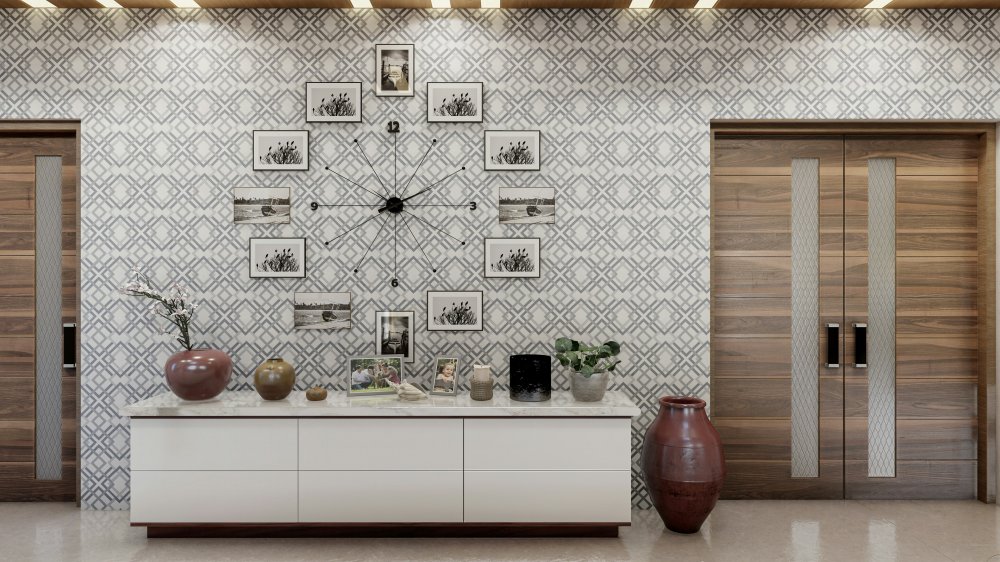
Texture seems to matter, too. Flat prints are lovely, but they don’t invite the eye or the hand to linger the way dimensional pieces do. If you’re rethinking a blank stretch of wall, something like 3D wall art for the living room gives you shadow, depth, and a tactile quality that a flat canvas simply can’t. It’s a small shift, but it changes how a room reads, and how it feels to sit in.
Choosing Art With Intention, Not Just to Fill a Wall
Here’s where the coaching brain and the decorating brain meet. So much of what ends up on our walls got there by accident, a gift we never loved, a print bought in a hurry to cover empty space before guests arrived. None of that is a crime. But if you’re doing the deeper work of building a life that feels like yours, it’s worth asking why a piece is there before you rehang it.
The APA Monitor on Psychology reported in 2025 that engaging with art activates the brain’s default mode network, the same system tied to introspection and self-reflection. In plain terms, looking at something you actually chose, rather than something that just happened to end up there, does something different in your head than looking at wallpaper you’ve stopped seeing. One meaningful piece, chosen slowly, does more for a room than five you grabbed because they were on sale. We talked about this same principle when creating a home that feels like a sanctuary, and it holds just as true for what’s hanging above your sofa as it does for what’s sitting on your shelves.
The Textures and Materials Making 2026 Living Rooms Feel Grounded
If you’ve scrolled through home accounts lately, you’ve probably noticed the shift toward texture: sculptural panels, layered abstract pieces, parametric woodcuts that cast shadows across the wall as the light moves through the day. It’s easy to write this off as another passing trend, but there’s a grounded reason it resonates.
A 2019 study in Frontiers in Psychology found that indoor exposure to natural and textural elements, plants especially, meaningfully reduces stress and supports focus, which is part of the broader biophilic design movement behind this dimensional style. Texture reads as organic. Organic reads as safe. Your brain notices the difference even when you’re just walking past.
This isn’t about matching a Pinterest board. It’s about noticing what pulls your eye and slows your breathing when you walk into a room, then bringing more of that in on purpose. That’s the same instinct behind why your living space deserves the same care as the rest of your self-care routine, and it applies directly to how you choose what goes on your walls.
Making the Change Without Overhauling Your Whole Room
You don’t need a renovation to feel this shift. Start with one wall. Pick a single statement piece and hang it above the chair where you actually sit, not the hallway nobody lingers in. Give yourself permission to spend a little on something that matters rather than a lot on things that don’t. U.S. households spend an average of $1,598 a year on decor and furnishings, so putting a portion of that toward one piece you genuinely love isn’t extravagant. It’s intentional.
If your walls still feel like a junk drawer of half-decisions, that’s worth addressing before you add anything new. Clearing the physical clutter that’s weighing on your mind first makes room, literally and otherwise, for the piece that actually deserves the wall.
Your Home Is Still Yours to Shape
Your living room is one of the few spaces you get to fully control. What hangs on its walls isn’t a small decision, even when it feels like one. Choosing texture and depth over something flat and forgettable is a quiet way of saying you’re paying attention to your own life again.
That’s really the whole point, isn’t it? Not a perfect room. Just a truer one, one wall at a time.
 Ready to begin making your surroundings fit the woman you’re becoming?
Sign up for 30 Days to Clarity Monthly News, and I’ll send you Optimize Your Energy, my free workbook for finding and fixing the little things that drain you.
You’ll also receive monthly encouragement for clearing clutter for your mind, body, and soul.
You May Also Find These Articles Helpful
 Life Isn’t Certain: But It Helps to Create a Plan
 Clearing Clutter from Your Home Can Be the Secret to Loving Your Life
 Begin Clearing Clutter from Your Mind with this Timeless Process
 Paradise Won’t Save Your Life, But It Can Show You What Your Heart Desires
 Thirteen Overlooked Strategies to Declutter Your Life and Mind