There is something that happens the moment you step through the gates of a Disney park. The noise of the parking lot fades. The street in front of you narrows just slightly, pulling your eye forward. A faint melody drifts from somewhere you can’t quite locate. You haven’t seen a single ride yet, and you’re already feeling it. That feeling has a name — but Disney never tells you what it is. They just build it, note by note, brick by brick.
The Architecture Speaks Before Anyone Does
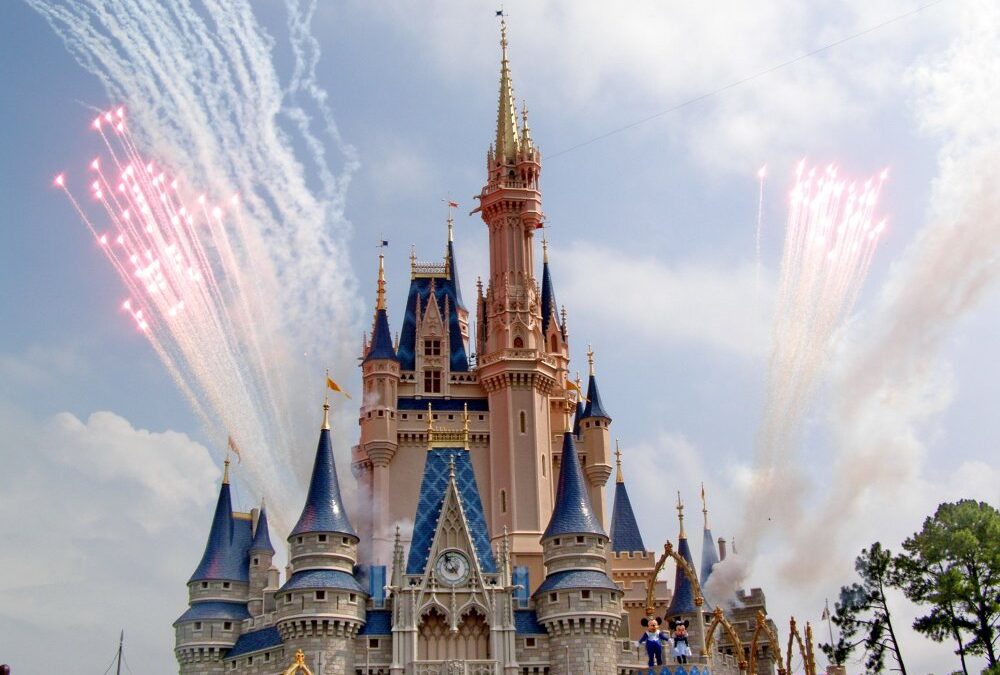
Walk down Main Street, U.S.A. and notice something odd: the buildings shrink as they get taller. The first floors are built at full scale. The second floors are slightly smaller. The third floors — where they exist — are smaller still. This technique, called forced perspective, makes the street feel longer and the castle at the end look more enormous than it actually is. Cinderella Castle at Walt Disney World stands 189 feet tall. It looks closer to 300. That’s intentional. Every visual detail in a Disney park is a deliberate choice made by a team of designers called Imagineers.
The same logic applies to color. Warm colors at the park entrance create a sense of welcome. As guests move deeper into lands like Fantasyland or Tomorrowland, the palette shifts — cooler, more saturated, or more dramatic depending on the mood being created. The architecture isn’t decoration. It’s direction.
Sound as an Invisible Hand
Disney parks use what’s known as a “sound progression” system. As you walk from one themed environment into another, the music transitions so gradually that you barely notice. The score for Adventureland doesn’t crash into the fanfare of Fantasyland. It fades and shifts. Researchers have found that background music tempo can influence walking speed and emotional state — and Disney has known this for decades.
Here’s a quick breakdown of how sound functions differently across the parks:
-
- Main Street, U.S.A. — upbeat, nostalgic, turn-of-the-century American marching bands and popular standards
- Haunted Mansion queue — dissonant organ music layered with environmental sound effects
- Pirates of the Caribbean — water sounds begin before the ride itself, blurring the line between waiting and experiencing
- Galaxy’s Edge — ambient electronic textures with no recognizable melodies, creating alienness
The silence is designed too. There are very few truly quiet spots in Disney parks, because silence creates uncertainty. Every zone has a sonic identity that tells guests where they are and how they should feel.
The Hidden Logic of Guest Flow
Theme park architecture is, at its core, crowd management dressed as storytelling. Walt Disney himself studied how people move through spaces. He noticed that visitors naturally gravitate toward visual anchors — tall structures, bright colors, movement. Disney parks are designed around “weenie” architecture: a visible landmark that draws guests forward.
The castle works as the central weenie. But each land has its own version. The Tower of Terror. Space Mountain. Splash Mountain. These aren’t just rides — they are visual punctuation marks that keep guests oriented and moving. The average guest at Walt Disney World walks 8 to 10 miles per day without realizing it. That’s not exhaustion. That’s engagement.
Planning the Disney Vacation in the Digital Age
Before the immersive design even begins to work on guests, most families spend weeks planning their Disney vacation online — comparing ticket options, booking hotels, and watching park vlogs. A lot of that research happens across different devices and regions. Some guests use a VPN like veepn.com to browse securely while comparing prices or accessing region-specific Disney content and deals, especially when traveling internationally or booking from abroad. It’s a small practical step, but for families investing thousands in a trip, protecting their payment information and browsing data makes real sense.
“The details are not the details. They make the design.” — Charles Eames
That quote lives in the DNA of every Disney park. The garbage cans are placed exactly 27 steps apart — the distance Walt observed people would carry trash before dropping it. The pavement in Fantasyland is a slightly different texture than in Liberty Square, subtly slowing foot traffic. These micro-decisions compound into something that feels like magic but is actually science.
Emotional Storytelling at the Ride Level
Disney attractions aren’t just thrill delivery machines. They are narrative arcs. Consider the original Haunted Mansion. The experience begins before boarding: the stretching room, the portraits, the ghost host’s monologue. By the time you sit in the doom buggy, you’ve already been introduced to the story’s tone, rules, and characters. The ride itself is act two.
Studies in experiential design show that the “peak-end rule” — coined by psychologist Daniel Kahneman — heavily influences how people remember experiences. Guests remember the most emotionally intense moment and the final moment of an experience, often ignoring the middle entirely. Disney builds around this principle. The final scene of a ride, the send-off music, the gradual return to daylight — these are crafted as carefully as the climax.
Family Entertainment Built on Emotional Architecture
What makes Disney parks singular isn’t the size of the budget — though it is enormous. Universal Creative spent roughly $500 million on just one land (The Wizarding World of Harry Potter). Disney routinely invests at that scale and beyond. What separates Disney is the philosophy: that every surface, every scent, every transition is a storytelling opportunity.
Children respond to this differently than adults. Kids live inside the fiction — they believe the cast member in a Cinderella dress is Cinderella. Adults watch their kids believe and feel something harder to name. That layered emotional response — wonder by proxy — is the most sophisticated trick in Disney’s design playbook. It’s why families come back. It’s why people cry at theme parks. It’s architecture doing the work of literature.
Issues of privacy and anonymity have also not gone away. Using the VeePN browser extension while streaming Disney park livestreams or planning content from geo-restricted platforms is another way enthusiasts stay connected to the magic year-round. What does it have to do with whether they’re at home counting down to their next trip or simply rewatching a favorite land’s ambient footage from thousands of miles away.
The Numbers Behind the Magic
Some figures are worth sitting with:
-
- Disney World spans 40 square miles — roughly the size of San Francisco
- The Magic Kingdom receives approximately 20 million visitors per year, making it the most visited theme park on Earth
- Disney parks employ over 70,000 cast members in Florida alone
- The underground tunnel system beneath Magic Kingdom (called “utilidors”) runs 5 miles, keeping operational staff invisible to guests
Each of these facts points to the same conclusion: the guest experience is the product, not the rides. The rides are vessels.
Visitor Engagement as the Final Metric
Disney has moved aggressively into technology-driven engagement in recent years — MagicBands, the Genie+ system, the PLAY! app. But the core design principles haven’t changed since 1955. Keep guests emotionally oriented. Give them beauty and surprise. Build transitions that feel like permission to feel something.
The themed entertainment industry has grown significantly in response to Disney’s model. According to the Themed Entertainment Association, the global theme park market was valued at over $50 billion in 2023, with continued growth projected through 2030. Disney’s influence on that market is hard to overstate — most major parks now employ narrative designers, not just engineers.
Disney parks don’t just tell stories. They build containers for emotion and then invite millions of people a year to walk inside. That’s the design. That’s the magic. It was never accidental.