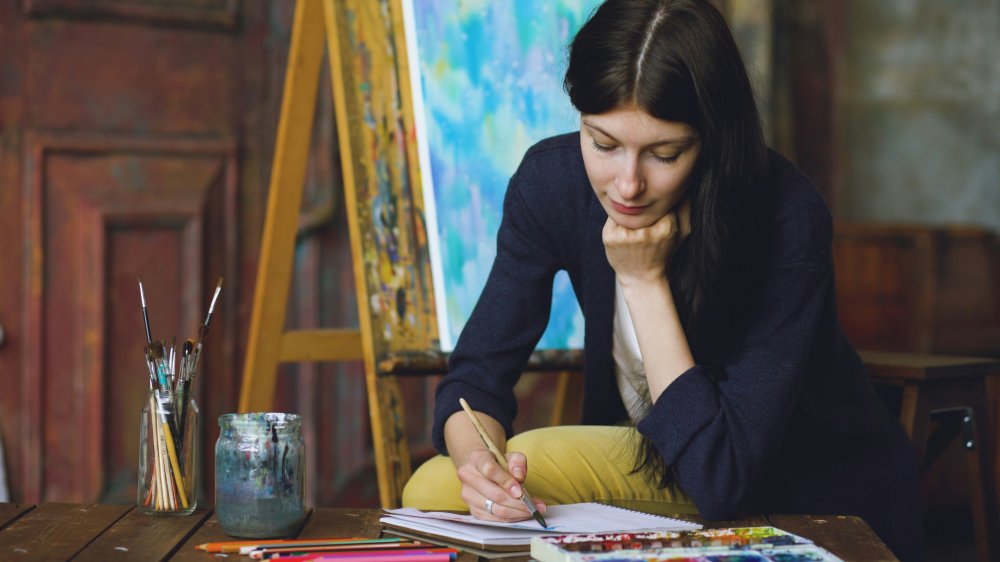
You know that hour after dinner when your brain is still running the day’s tape on a loop? The email you didn’t answer, the thing your kid said at pickup, the sixteen tabs open in your head. I used to reach for my phone in that hour, darling, like it was going to soothe me. It never did. What actually quiets things down, more often than I expected, is something almost embarrassingly simple: a paintbrush and a canvas with little numbers printed on it.
No app, no subscription, no breathing coach in your ear. Sometimes the low-tech option is the one your nervous system was actually asking for.
Why a Simple Canvas Can Quiet a Busy Mind
Part of what makes a busy mind busy is the sheer volume of decisions it’s juggling. What to make for dinner, what to say in that email, whether you left the stove on. A blank sketchbook page doesn’t help, because now you’ve added one more decision: what do I even draw? A numbered canvas removes that tax. The decisions are already made for you. You just pick a section and fill it in.
That’s part of why so many people start by paint by number online, scrolling through designs until one – a coastline, a bowl of lemons, a cat curled on a windowsill – actually pulls at them. There’s no blank-page pressure. You’re not being asked to create from nothing. You’re being asked to notice color, shape, and pattern, one small section at a time. That’s a much easier door to walk through when your mind is already tired.
It isn’t just a nice theory, either. A study of more than 93,000 adults across 16 countries, published in Nature Medicine and covered by Harvard Health, found that people who had a hobby reported better overall health, higher happiness, and fewer symptoms of depression – and the benefits held even though more than 60% of participants were already managing a physical or mental health condition. A hobby isn’t a cure-all. But it’s doing real work.
The Science Behind Why It Works
Here’s the part I find genuinely interesting. It’s not just that painting is relaxing in a vague, hand-wavy way. Researchers have actually measured what’s happening.
A 2025 meta-analysis in the Journal of Psychiatric and Mental Health Nursing, led by Huang and colleagues, pooled 35 randomized controlled trials with more than 3,000 adult participants and found visual art therapy produced a significant reduction in anxiety symptoms. We’re not talking about a marginal effect. The size of that reduction was large enough that the researchers called it one of the more consistent findings in the arts-and-mental-health literature.
A separate 2025 review in Nature Mental Health, covering 39 studies on group arts interventions, found a moderate reduction in depression symptoms and a similar moderate reduction in anxiety. Moderate isn’t dramatic. But moderate, sustained over weeks, adds up to something that starts to feel like relief.
What both papers point back to is something close to flow state, the mental groove you fall into when a task is absorbing enough to hold your attention but not so hard it stresses you out. Repetitive, structured motion – filling in shape after shape – seems to be particularly good at getting people there without them having to try. It’s the same territory I touched on when I wrote about the flow state that quiets a busy mind: the frivolous-looking things that happy people do aren’t actually frivolous at all.
One limitation worth naming: painting by numbers isn’t therapy, and it won’t resolve a clinical anxiety disorder on its own. Think of it as one tool in a fuller kit, not a replacement for harder work with an actual professional.
Making It Part of Your Self-Care Routine
The trick with any self-care habit is that it dies the moment it becomes one more obligation. Don’t treat this like a project with a deadline. Treat it like fifteen or twenty minutes off from problem-solving.
Keep your supplies somewhere visible – on the coffee table, not shoved in a closet – because friction kills good intentions fast. You’re far more likely to sit down for a short session if the canvas is already out. And you’re allowed to stop mid-section. Nobody’s grading the finished piece.
This isn’t a fringe habit, either. According to APA polling data widely cited in 2025 coverage, 46% of Americans already use creative activities like painting, crocheting, or puzzles specifically to relieve stress or anxiety. You’d be joining a fairly large, quietly determined club. If you’ve been making time for a creative outlet feel indulgent or hard to justify, that number might change your mind.
Starting Small, Starting Today
You don’t need to overhaul your evenings or buy six new canvases this week. Pick one design, set a twenty-minute timer, and let your hands do something slow and small. It’s a lot like picking up a new skill in that the hardest part is just starting.
A 2025 scoping review by Cleary and colleagues, published in Issues in Mental Health Nursing, found that people without depression at baseline had 32% lower odds of developing it if they had a regular hobby. Not a guarantee. Just better odds.
Reclaiming Calm Doesn’t Take a Grand Plan
You don’t need a five-year plan to feel less wound up by Tuesday night. You need one small, repeatable thing that asks less of you than your inbox does. A paintbrush, a numbered canvas, twenty quiet minutes. That makes a difference. That’s a lot of what falling back in love with your own life looks like, one small permission at a time.
Want to learn more tools to help you love your life?
Snag a free workbook and get inspiration .
>>Discover More Ways to Love Your Life and Yourself<<
You May Also Find These Articles Helpful
 What You Need to Know If You’re Feeling Burnt Out and Exhausted
 Meditation Without Fear: Five Simple Tricks to Help You Begin a Meditation Practice
 Nine Simple Yet Powerful Ways to Reconnect with Your Inner Self
 Having a Good Life Doesn’t Mean You Shouldn’t Dream of Having More
 Getting Back to Gratitude: Nine Ways to Practice It