
A personal syllabus sounds a little trendy, I know. It also sounds suspiciously close to homework. And depending on your relationship with school supplies, that may either delight you or make you want to go lie down. But stay with me, because this idea doesn’t have to be stiff, academic, or another self-improvement project wearing a cute outfit.
At its best, a personal syllabus is simply a way to give your curiosity somewhere to go. It’s a place to gather the books, ideas, questions, classes, documentaries, podcasts, recipes, walks, conversations, art, and tiny experiments that actually interest you. Not because you’re trying to become a shinier, more optimized version of yourself by next Tuesday. Please. But because your free time, your attention, and your interests are already shaping your life, and maybe you’d like to have a little more say in the matter.
August feels like a natural time to think about this. Even if you haven’t bought a notebook for a class in decades, there’s something about back-to-school season that whispers, “Maybe we could learn something new.” The air shifts. The calendar starts feeling less like summer sprawl and more like a fresh page. And while nobody needs to turn adulthood into a syllabus with attendance points, there is something lovely about asking, “What do I want to study, practice, explore, or understand in this next season of my life?”
The goal of creating a personal syllabus is simple: to build a life that keeps your mind awake, your heart engaged, and your days from disappearing into one long scroll.
Your Free Time Is Already Teaching You Something
The thing about free time is that it doesn’t stay neutral. What you watch, read, scroll, save, repeat, avoid, and return to is already teaching you something. It may show you what you care about, what drains you, or what your brain starts believing after too much time watching everyone else look ahead, prettier, better dressed, better organized, more disciplined, and apparently capable of making protein-rich lunches in glass containers while you’re wondering if coffee and crackers count as a meal.
And listen, this is not a shame spiral about scrolling. Almost everyone I know scrolls through something. Sometimes the brain is tired and wants a little nonsense. There is nothing morally superior about refusing every meme, reel, recipe video, or oddly specific rabbit hole about how people organize their pantries. The issue isn’t that you consume content. The issue is when your free time gets swallowed by a stream of things that keep your brain busy but don’t actually leave you feeling fed.
You know that feeling. The weekend ends, and you’re not quite sure what you did with your open pockets of time, but your thumb had a very active social life. You consumed plenty, yet very little stayed with you. The ideas blurred past before you could follow them. Your innate sense of curiosity never got tended. The small experiences never quite made their way into your actual life. That’s where a personal syllabus can help. It gives your attention a direction that isn’t rigid, but is more nourishing than another hour of “just checking.”
This doesn’t mean every bit of free time needs to become educational. I would never say that to you, my dear. Because things like rest and play matter! Doing absolutely nothing while wearing soft pants matters. But if you keep feeling like your attention is scattered everywhere and your life still feels oddly underfed, it may be time to choose a few threads you actually want to follow on purpose.
Choose What You Actually Want to Explore
The first step is not to make a list of everything you think you should improve. That is how a personal syllabus turns into punishment with a nicer font. You aren’t here to create a curriculum called “How to Finally Become Acceptable.” We are not doing that. Absolutely not.
Instead, notice what genuinely peaks your interest. Pay attention to the things you keep saving, circling, mentioning in conversation, or wanting to understand better. Ask what makes life feel more interesting to you, not more impressive to someone else. Maybe you’re drawn to writing or faith, but maybe you also want to read Shakespeare’s sonnets, learn everything about Henry VIII’s six wives, understand how eagles live, figure out why certain paintings stop you in your tracks, make better soup, grow peonies, study a little local history, take a class in something wildly impractical, or finally learn enough about poetry to stop pretending you “don’t get it.” Curiosity doesn’t have to be serious to be worthwhile. Sometimes the thing that lights you up is useful, and sometimes it is simply fascinating.
Pick two subjects, not twelve. The point is not to design a full semester with office hours and a grading rubric. It’s to choose a couple of things you’d genuinely enjoy investigating. Maybe one is practical and one is purely fascinating: learning to bake bread and reading about women artists of the Renaissance, understanding birds in your backyard and exploring classic detective novels, studying the architecture in your own city and learning how to make three excellent sauces, or reading a stack of biographies about women who lived very different lives from yours.
These don’t have to become expertise, credentials, or even permanent interests. They just need to be interesting enough that you want to keep following the thread. This can change by season, which is part of what makes it useful. Your August syllabus may feel different from your January syllabus. Your post-burnout syllabus may look different from your creative-expansion syllabus. And your midlife syllabus may not resemble anything your twenty-five-year-old self would have chosen, thank heavens. You’re allowed to let your curiosity grow up with you.
Let Curiosity Become Something You Do
Once you choose your subjects, gather a few things to help you follow them. Not fifty. Not a digital dragon hoard of saved links you’ll never open again. A few. Maybe a book, a documentary, a podcast episode, a local class, a museum exhibit, a recipe, a walking route, or someone whose work makes you want to know more. Give yourself enough material to play with, not enough to accidentally create a graduate program.
Because collecting can feel wonderfully productive right up until you realize you’ve spent two hours making the perfect list and haven’t actually done anything with it. Thirty recipes can be saved while dinner still happens standing at the counter. A dozen books can be added to a cart while the one already on your nightstand quietly judges you. The syllabus is not the point. Letting your curiosity move into your actual life is.
So do something with what you’re learning. Read a chapter. Try the recipe. Visit the place. Watch the documentary and tell someone what surprised you. Go look at the building instead of only reading about it. Learn enough about a bird to recognize it when it lands in your yard. Follow the question far enough that it becomes part of the way you see the world.
That’s what keeps a personal syllabus from becoming another folder of good intentions. It should leave little traces behind: a place visited, a dish made, a book underlined, a conversation sparked, a new obsession acquired. Curiosity is much more fun when it gets out of the folder and into your life.
Let Your Syllabus Grow With You
The loveliest part of a personal syllabus is that it becomes a record of what is shaping you. Not in a precious “look at me becoming” way, but in a very ordinary, satisfying way. You can look back and see what you followed, what you tried, what bored you, what surprised you, what made you feel more alive, and what quietly became part of your rhythm.
One subject may fade because it was more appealing in theory than in practice. Fine. That’s information, not failure. A book may open a door to another book. A recipe may become a Sunday ritual. A walk may turn into a habit. An article may make you rethink the way you spend your attention. A museum afternoon may remind you that you are not only a person who handles tasks, but also a person who can be moved, interested, amused, challenged, and delighted.
That matters, especially in seasons where life gets practical and your inner world starts feeling a little under-tended. Bills, errands, work, caregiving, home, appointments, and laundry can take up so much space that curiosity begins to feel like a luxury. But curiosity is not frivolous. It’s one of the ways you stay connected to yourself. It reminds you that you are still growing, not because you are incomplete, but because you are alive.
So build the syllabus lightly. Keep it somewhere you’ll actually see it: a notebook, a binder, a document, a note on your phone, or a folder with actual limits so it doesn’t become a swamp. Revisit it when the season changes. Cross things out. Add things in. Let it be useful without becoming another thing you have to maintain perfectly.
Let It Shape the Life You’re Actually Living
A personal syllabus is not about proving you’re disciplined. It’s about choosing what gets to shape you. It’s a way of saying, “I don’t want my attention scattered into whatever the algorithm serves me next. I want to follow what keeps calling me. I want to make room for ideas, places, people, books, recipes, questions, and odd little fascinations that make my life feel more like mine.”
And maybe that’s the real beauty of it. You don’t have to become wildly educated in every subject that interests you, although I support this fantasy completely. You just begin spending your time in ways that leave a trace: a book underlined, a recipe tried, a museum visited, a bird finally identified, a question followed far enough to become a new obsession. Slowly, your life gets more interesting to the person actually living it.
 What Is Your Curiosity Trying to Tell You?
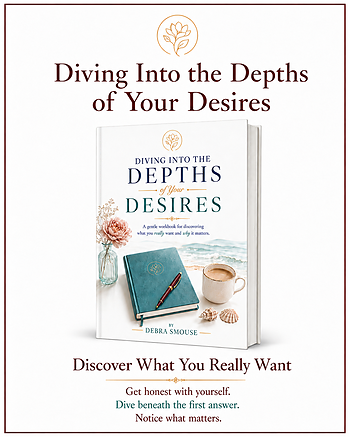
If your personal syllabus keeps circling the same interests, questions, or possibilities, that may be worth paying attention to. Diving into the Depths of Your Desires can help you look more closely at what you want and what may be asking for more room in your life.
Diving Into the Depths of Your Desires is a reflective workbook for exploring what you really want, what you may have outgrown, what keeps calling for your attention, and what might be worth making more room for. Through guided reflections, questions, and exercises, it helps you move beyond the sensible first answer and get curious about the woman you are now.
Purchase Diving Into the Depths of Your Desires