
Your inner wisdom can get hard to hear when everyone else has advice for your life before you’ve even finished your coffee. There’s a proven morning routine for everything. A five-step framework for every problem. A podcast episode for every mood. A carousel for every crisis. A thought leader ready to tell you what to do, how to think, who to become, what to heal, what to optimize, and why your current approach is probably the reason your life hasn’t transformed by Thursday.
And listen, I love learning. I love a good book, a helpful podcast, a thoughtful conversation, and a sentence that makes me stop and stare out the window like it just rearranged the furniture in my brain. Advice can be useful. Outside perspective can be generous. I’ve written before about why it’s often easier to give advice than take it, but this is the other side of the same coin: sometimes we are surrounded by so much advice that we forget to ask what we actually know.
That’s where things get tricky. Because the more you consume, the more productive it can feel. You are researching. Learning. Gathering. Considering. Saving ideas for later. Highlighting sentences. Nodding along while someone explains your life to you through earbuds. But if every answer comes from outside of you, eventually your own voice starts getting quieter. Not because it disappeared, but because it cannot compete with a 24-hour advice machine wearing cute fonts.
So maybe the next step is not another expert, another template, another course, another routine, or another “you have to try this” recommendation. Maybe the next step is to pause long enough to ask, “What do I actually know about my own life?”
Too Much Advice Can Drown Out Your Own Voice
We are living in the age of answers. Self-help used to be a quiet corner of the bookstore. Now it is everywhere. Videos, newsletters, reels, podcasts, masterclasses, morning routines, habit stacks, productivity systems, nervous system tips, relationship rules, business strategies, wellness trends, and someone on the internet explaining, with great confidence, the exact reason you are tired, stuck, blocked, behind, or not drinking enough water.
Some of it is genuinely helpful. Some of it is beautifully said. Some of it may be exactly what you need in the right season. But too much self-help input can start to feel like mental clutter. You read one thing, save another, listen to three opinions, scroll through ten more, and by the end of the day your brain feels stuffed but strangely underfed. Full of other people’s ideas, but not especially connected to your own.
That is the cost of constant advice. It can make you feel informed without making you clearer. It can make you feel busy without helping you move. It can make you feel like the answer must still be out there somewhere, hiding in the next post, the next episode, the next framework, the next woman with perfect lighting and a suspiciously calm nervous system.
Inspiration Is Not the Same as Alignment
There is nothing wrong with being inspired by someone else’s way of doing things. Sometimes another person’s system, story, or structure gives you the language you needed. Sometimes it opens a door. Sometimes it helps you see a possibility you could not see from inside your own tired little thought spiral. We love a helpful nudge.
But inspiration is not the same as alignment. Someone else’s morning routine may be brilliant and still not fit your body, schedule, personality, responsibilities, hormones, season of life, or general tolerance for chirpy behavior before sunrise. Someone else’s productivity system may work beautifully for them and make you want to throw your planner gently into a pond. Someone else’s advice may be wise, but not yours.
That is where discernment comes in. Not every good idea deserves a place in your life. Not every expert needs to become your authority. Not every strategy is meant to be copied wholesale. You are allowed to ask, “Does this actually fit me?” before you rearrange your life around advice from someone who does not know your calendar, your energy, your marriage, your health, your work, your grief, your capacity, or the fact that your dishwasher currently sounds like it is training for a haunted house.
Your Inner Wisdom Needs Space to Be Heard
Your inner wisdom is not usually dramatic. It does not always arrive with a spotlight and a firm announcement. More often, it shows up as a nudge, a tightening, an exhale, a quiet knowing, a repeated thought, a sense that something fits or does not fit. But it needs space. It needs a little quiet. It needs a moment where every other voice is not shouting over it.
That might mean journaling before Googling. Walking without a podcast. Sitting with the question for one full day before asking five people what they think. Letting yourself be bored long enough for your own thoughts to surface. Turning off the input and asking, “What do I already know, even if I do not want to admit it yet?”
This can feel uncomfortable if you are used to outsourcing the first draft of your decisions. Advice can become a very respectable hiding place. As long as you are still researching, you do not have to choose. As long as you are still gathering opinions, you do not have to risk being wrong. But clarity often comes when you stop collecting and start listening inward, which is rude because listening inward does not usually come with bullet points and a downloadable workbook.
Small Decisions Help You Trust Yourself Again
Trusting your inner wisdom does not mean you suddenly become a woman who receives perfect guidance from the clouds while making soup. It usually starts much smaller than that. It starts with the everyday choices that help you practice hearing yourself and responding.
You read three pages instead of scrolling. You take the walk because your body is asking for air. You pause before saying yes because your first answer may be people-pleasing, not truth. You put on music and let yourself actually listen. You choose the meal that feels good instead of the one some influencer told you was morally superior. You stop asking the entire committee of the internet what your life should feel like and choose one thing that feels honest in your actual day.
Those small decisions matter because they create evidence. Every time you listen to yourself and act on it, even in a tiny way, you teach your system that your voice counts. You prove that wisdom is not only something you collect from the outside. It is also something you build through attention, practice, and trust in your own lived experience.
Build a Life That Feels Like Yours
The goal isn’t to stop learning from other people. Books, teachers, podcasts, wise friends, and helpful conversations can all open a window when you need one. The problem begins when outside advice starts outranking your own life, as if everyone else’s system knows more about your days, your needs, your limits, and your longings than you do.
A life that feels like yours is built by noticing what actually supports you. What gives you energy. What drains you. What keeps showing up as true. What feels like care instead of punishment. Before you reach for one more answer, give your own life a chance to speak first.
You can still take in good advice. You can still learn, listen, ask, read, and grow. Just don’t hand your authority away so quickly that your own wisdom never gets a turn. Your inner wisdom doesn’t need to be louder than the whole world. It only needs enough quiet, respect, and practice to become recognizable again.
Learning to Take Your Own Advice Builds Self-Trust.
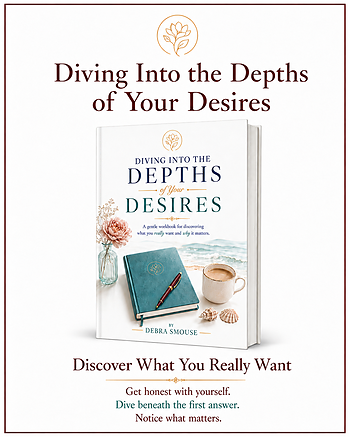 Diving Into the Depths of Your Desires
What do you really want?
It sounds like a simple question until you try to answer it without immediately considering what’s practical, expected, or easiest for everyone else.
Diving Into the Depths of Your Desires is a reflective workbook designed to help you listen beneath the first answer, notice what you want more of and less of, and become curious about what your desires may be telling you.
You don’t have to reinvent your life. You only need enough honesty to hear yourself.
Purchase Diving into the Depths of Your Desires here.